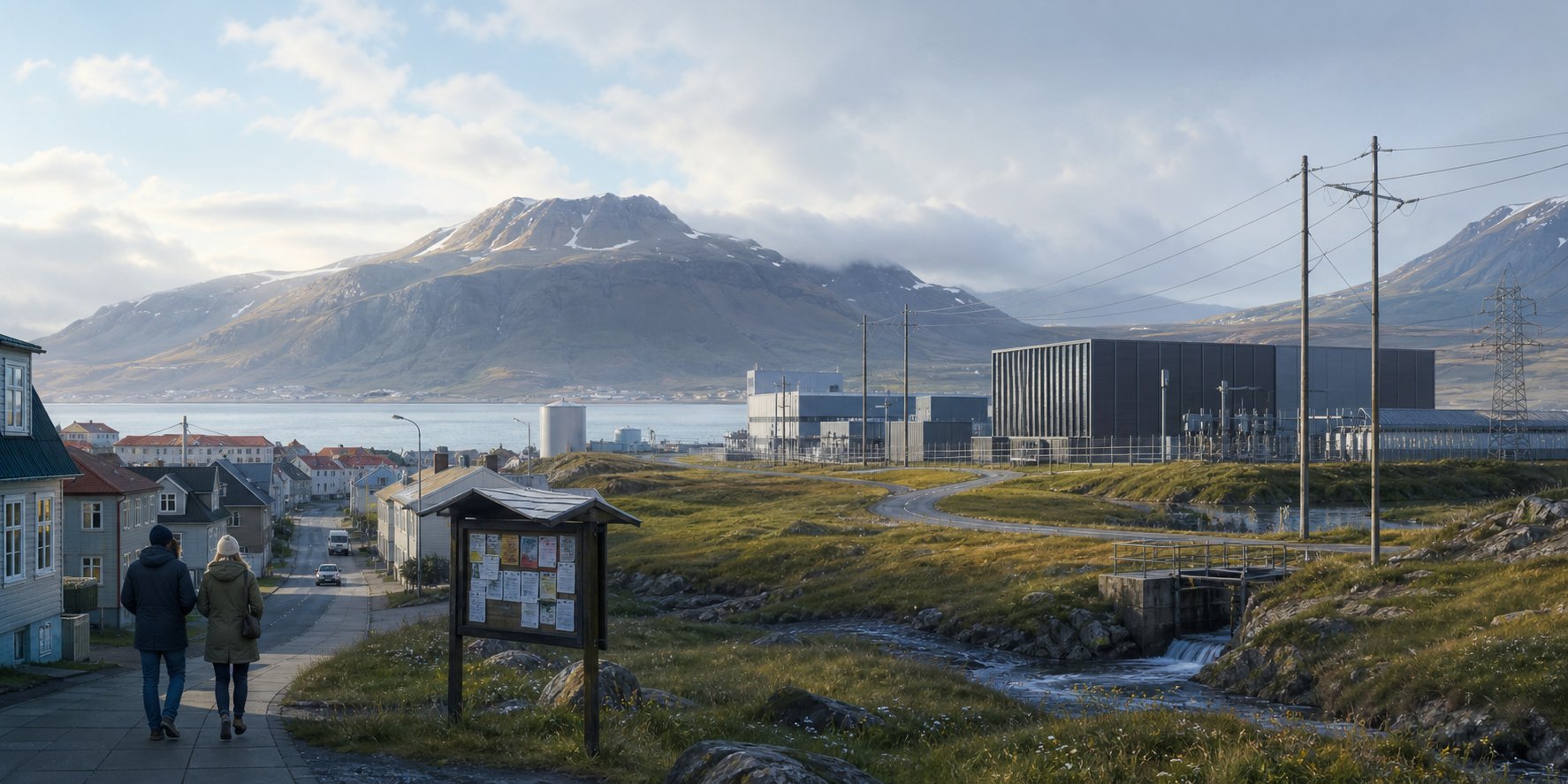
The backlash against AI infrastructure will not be solved by telling people to stop worrying. It will be solved by giving communities enforceable standards before the buildout reaches them.
Imagine this.
You show up for a town meeting on a Tuesday night in your hometown. The room is full in that half-restless, half-curious way small public meetings can be full. People have come straight from work. Someone still has paint on his hands. Someone is holding a paper coffee cup. Someone brought a notebook because she has questions.
The mayor stands up and explains why everyone is there.
An AI data center company is interested in building nearby.
The mayor sees opportunity. New investment. New tax revenue. Maybe new jobs. Maybe a chance to put the town on the map.
But people in the room also start doing the math in their own heads.
How much electricity will it use?
Will our bills go up?
What about water?
Will we hear the cooling systems at night?
Will it become a huge windowless box on land people love?
Who gets the money?
Who lives with the tradeoffs?
One person is worried about the electric bill. One is worried about the well. One has heard the fans will hum all night. One wants the jobs. One wants the tax money. One thinks AI is the future. One thinks the town is being used.
None of them are stupid.
They are looking at the same thing from different lives.
And that is the point the meeting makes visible.
For most of us, AI has felt weightless. It arrives through a phone, a laptop, a search box, a chatbot, a picture generator. It feels like software. It feels like something happening somewhere else.
But when a data center comes to town, AI stops being an abstract tool and becomes a neighbor.
That is when people start to see what has been true all along:
The cloud is not a cloud.
It is land, electricity, water, cooling systems, transmission lines, backup generators, noise, tax agreements, local permits, and people living near the consequences.
That is why the growing backlash against AI data centers in the United States should not be dismissed as ignorance or anti-technology fear. It is a warning that the public is asking a reasonable question:
If this technology is going to transform the world, who pays for the physical footprint?
According to Gallup, seven in ten Americans oppose the construction of an AI data center in their local area, including nearly half who strongly oppose it. The reasons are not mysterious. People worry about water, power use, grid strain, environmental impact, noise, quality of life, rising utility costs, and whether their community is being asked to carry costs while someone else captures the upside.
The striking part is that this concern cuts across political lines. In a polarized country, opposition to data centers has become one of the rare issues that can unite progressive climate activists, rural landowners, local homeowners, ratepayers, and people who simply do not trust large companies to explain the full cost before construction begins.
The tech industry should not answer that with condescension.
People who ask about electricity are not enemies of the future. People who ask about water are not enemies of progress. People who ask who benefits, who pays, and who lives with the noise are asking the minimum questions a democratic society should ask before approving major infrastructure.
This is why the issue travels so strangely across party lines. Different groups arrive from different doors, but they are often pointing at the same missing standard.
For conservatives, this can be a question of property, local control, ratepayer protection, and whether distant corporations should be allowed to reshape a town without real consent.
For progressives, it can be a question of climate, water, environmental justice, corporate accountability, and whether technological progress is again being built on communities with less power than the companies making the deal.
For local officials, it is a question of whether tax revenue today is worth infrastructure pressure tomorrow.
For people who believe in AI, it is a question of trust. A technology this powerful cannot afford to look like another machine that takes from a place and leaves ordinary people with the bill.
Those are not separate arguments. They are one argument seen from different places:
Who carries the cost of the future?
But a flat "no" is not enough either.
Some people may wish AI would simply go away. That feeling is understandable.
But it is not a plan.
AI is already being built into search, phones, software, business tools, schools, hospitals, defense systems, science, entertainment, and government services. Even if a town says no to one data center, the national and global buildout will continue somewhere.
So the real choice is not between "AI exists" and "AI disappears."
The real choice is whether communities get standards before the buildout reaches them.
AI will need energy. That is not going away. The question is whether we let it grow according to the old industrial pattern: build fast, push costs onto other people, promise jobs, fight residents, patch consequences later.
We need a better standard.
If AI increases energy demand, AI must also help solve energy.
That sentence should become a public test.
Not only for the companies building data centers. Not only for the politicians approving them. Also for those of us who believe AI can become part of a good society.
The question should not be only, "How quickly can we build?"
The questions should be:
Does this project strengthen the community that hosts it?
Does it pay its real infrastructure cost?
Does it reduce strain on the grid, or only add strain?
Does it use water, heat, land, and power better than the systems it replaces?
Does it create lasting local value, or mostly short-term construction work and long-term resource demand?
Were residents informed early enough to shape the decision, or only after the deal was politically difficult to reverse?
These are not anti-AI questions. They are adult questions.
Real future technology should be able to answer them.
The bridge matters here. A data center should not be treated like an island dropped into a town. It should be treated like part of the local system it enters. If it draws power from the grid, it has a duty to strengthen that grid. If it uses water, it has a duty to minimize, recycle, replenish, or transparently justify that use. If it receives tax benefits, it has a duty to show public value beyond corporate growth.
That is the difference between extraction and partnership.
Extraction says: there is cheap land, available power, weak resistance, and a favorable tax deal. Take what can be taken.
Partnership says: if we arrive with a large demand, we also arrive with investment, transparency, technical help, measurable benefit, and respect for the community that hosts us.
AI itself can be part of that partnership.
It can help forecast grid load, optimize energy use, identify waste, model better cooling, accelerate materials research, improve battery design, support water-risk analysis, and help local governments understand tradeoffs before they sign away leverage. If AI is as powerful as its builders claim, it should not only generate text, images, code, and profits. It should help solve the infrastructure problems that its own expansion makes more visible.
That does not mean every data center is justified. Some projects should be rejected. Some should be delayed. Some should be redesigned. Some communities will reasonably decide that the benefits do not match the burden.
But the national conversation should not collapse into two bad choices: let Big Tech build wherever it wants, or stop AI infrastructure entirely.
The better path is simple:
Not blind yes.
Not blind no.
A clear standard before approval:
AI infrastructure must leave the systems it touches stronger than it found them.
That can become practical very quickly.
Before a community approves an AI data center, it should be able to demand clear answers to at least seven questions:
- How much electricity will the project use at full buildout, and who pays for the grid upgrades?
- How will the company prevent local households and small businesses from absorbing higher utility costs?
- How much water will be used, where will it come from, and what happens during drought or heat stress?
- What noise, light, and visual-design standards will apply, and will the building fit the place instead of scarring it?
- Who measures those standards, and what penalties exist if the company fails?
- What permanent local jobs, tax revenue, infrastructure improvements, or community benefits are guaranteed in writing?
- How much clean power, storage, efficiency, waste-heat reuse, or grid-support investment comes with the project?
- Who verifies the promises after approval: the company, the local government, or an independent public process?
If those questions cannot be answered clearly, the project is not ready.
If they can be answered clearly, the conversation changes. Residents are no longer being asked to trust a future they cannot inspect. They are being given a standard they can hold.
That means transparent water reporting. Transparent power demand. Real community input before approval. No quiet transfer of grid costs onto households. Serious noise standards. Local benefit agreements with teeth. Investment in clean power, storage, efficiency, and grid upgrades. Independent measurement, not only corporate promises.
The next step is not only protest. It is civic leverage.
Residents can ask city councils, county boards, and state lawmakers to adopt an AI infrastructure responsibility standard before projects are approved. Such a standard does not have to be complicated. It can say:
No approval without full power and water disclosure.
No approval without a clear plan for who pays for grid upgrades.
No approval without enforceable noise, water, visual-design, and environmental protections.
No approval without a community benefits agreement that names local gains in writing.
No approval without independent verification after the project is built.
That gives each side a better path.
Communities get more than outrage. They get a checklist, a public process, and a way to distinguish a responsible project from an extractive one.
Local officials get more than pressure. They get a standard they can point to when negotiating with companies.
AI companies get more than resistance. They get a path to trust: prove the project strengthens the place that hosts it.
And people who believe in AI get a better argument than "trust the technology." They can say: "AI should be built in a way that helps communities, grids, and public systems become stronger."
This is how we calm the debate: not by telling people to worry less, but by making the concerns answerable.
The backlash in America is not simply a rejection of AI. It is a rejection of being told that the future is inevitable, and that ordinary people are supposed to adapt after the deal is already done.
That reaction is healthy.
Every powerful technology has to learn the same lesson:
The future does not earn permission by being the future.
It earns permission by showing responsibility.
If AI is going to enter our towns, grids, schools, hospitals, workplaces, and homes, then it must be held to a higher standard than speed.
It must be good for the people and systems it affects, not only for the companies that build it.
Not less AI.
Better AI.
Not less future.
A future that can carry its own weight.
I thank A. for deep conversation, critical review, and an important contribution to the structure of the frame.
Working Source Notes
Gallup News, May 2026: seven in ten Americans oppose local AI data center construction; resource, water, energy, environmental, and quality-of-life concerns are central.
Spotlight PA / Grist, June 2026: data-center backlash is described as unusually bipartisan, with opposition across Democrats and Republicans.
Axios, June 2026: water has joined energy as a top AI infrastructure flashpoint; transparency and environmental accountability are becoming central.
Harvard Gazette, April 2026: community concerns include rising electricity rates, water use, tax breaks, environmental effects, and limited long-term job creation.
MultiState, April 2026: state and local lawmakers are advancing data-center legislation on energy costs, reporting, siting, and moratoriums.